

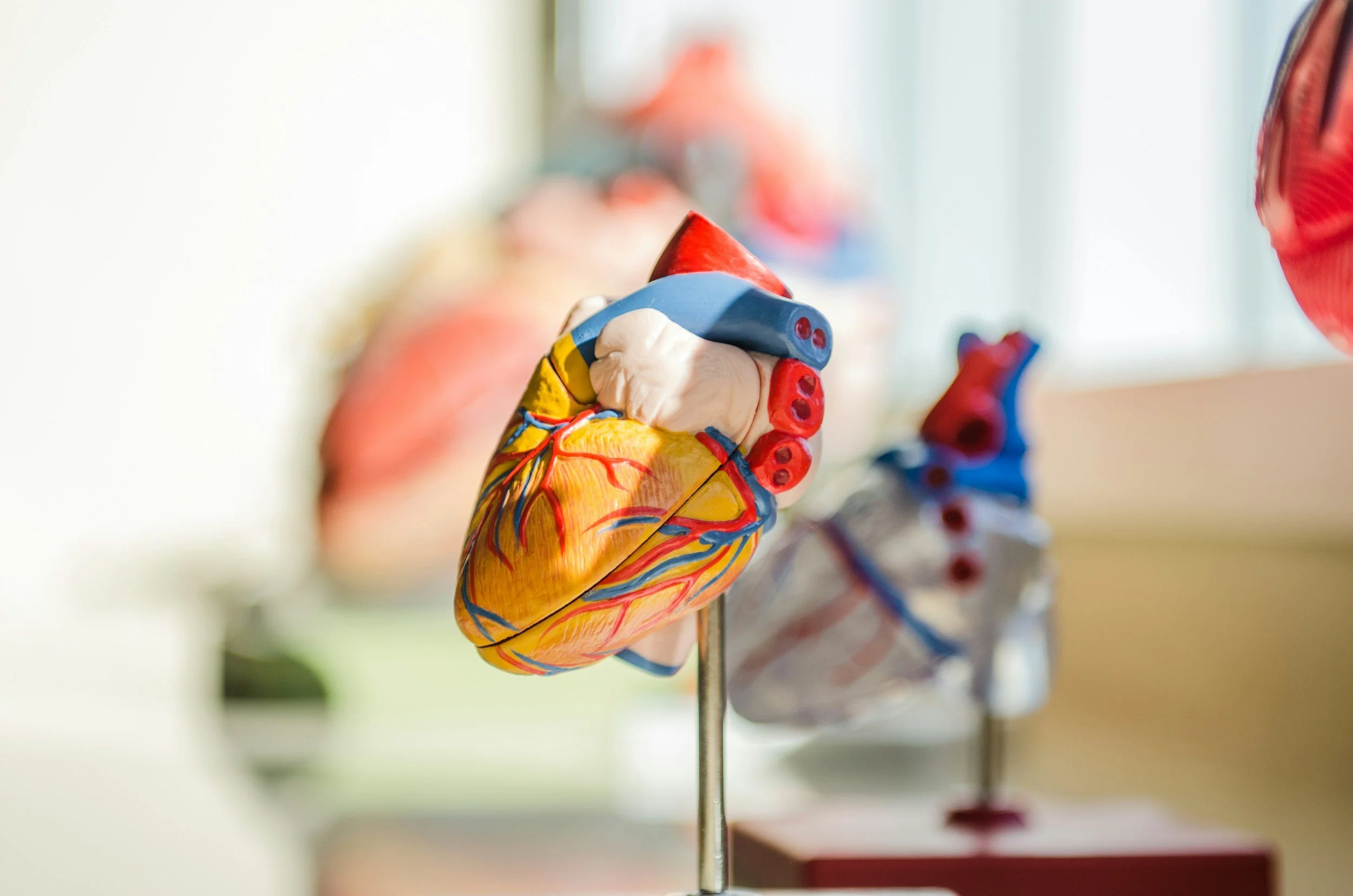
TCM Perspective: The Heart
How does TCM Philosophy interpret the Heart (Xīn, 心) Organ?
Chinese medicine theory can often sound like magical thinking to those not familiar with the concepts or culture. It is based on the history of how historical Chinese doctors viewed the human body, its functions, as well as nature, and the body’s connection with the world. Traditional Chinese medicine theory is built upon several key principles like Qi, Yin, and Yang, and the 5 elements that shape its approach to health and healing. The TCM Heart holds both physical (i.e., the pumping of the heart) and psychological dimensions (i.e., housing the Shen).
The Heart is called the sovereign organ, the root of life, the governor, and is in charge of spirit and vitality. It is responsible for the circulation of blood in the entire body and for mental activity. It is the vessel for the storage of sovereign fire and governs yang qi. The nature of the Heart is conservative and inward, preferring calm and disliking heat. So when pathogenic heat is invading the body, it tends to cause dysfunction in the Heart.
Information from: Deadman’s Manual of Acupuncture, CAM, Foundations of Chinese Medicine, & Huangdi Neijing.
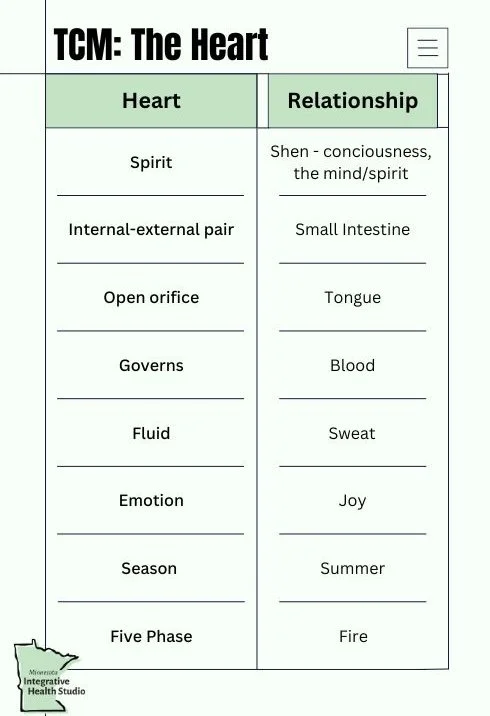
*TCM patterns are not referring to the physical, biomedical organs listed below, but rather the Chinese medicine interpretation of these organ systems
Main Functions of the Heart from A Manual of Acupuncture
The Heart Governs Blood & Blood Vessels
The transformation of Gu Qi (food qi) into blood takes place in the Heart.
It is responsible for the circulation of blood in a similar way to Western medicine (in TCM, the Lungs, Spleen, and Liver also play a role in this).
Heart Qi promotes contraction of the Heart and ensures blood vessels are elastic and smooth.
Heart Qi is the motive force that keeps blood continuously circulating inside the vessels.
The Heart Opens into the Tongue
The Heart Luo-connecting channel connects with the root of the tongue and the eyes.
If the heart is overactive or stressed, it can result in incessant talking and stuttering.
The tongue is considered an offshoot of the heart.
Practitioners examine the tongue’s color, shape, and coating at the tip to assess Heart blood flow, vitality, and underlying emotional health.
The Heart Houses the Shen (mind)
The Shen corresponds to the mental activities that ‘reside’ in the Heart. The state of the Heart (and blood) affects mental activity and emotional state.
The Heart governs blood, and blood is fundamental for mental and physical activities. This blood also nourishes the Shen.
The Shen is responsible for consciousness, thinking, affections, memory, and sleep.
The Heart Governs Sweating
There is a link between heart function and perspiration.
What we now know as the autonomic nervous system controls both heart rate and sweat gland activation.
Sweating patterns help practitioners evaluate your overall health.
Example: Sweating during minimal physical exertion often points to Qi deficiency (especially Heart or Lung)
The Heart Governs Blood & Blood Vessels
The transformation of Gu Qi (food qi) into blood takes place in the Heart.
It is responsible for the circulation of blood in a similar way to Western medicine (in TCM, the Lungs, Spleen, and Liver also play a role in this).
Heart Qi promotes contraction of the Heart and ensures blood vessels are elastic and smooth.
Heart Qi is the motive force that keeps blood continuously circulating inside the vessels.
The Heart Manifests in the Complexion
The face has an abundant network of blood vessels, and the radiance, color, and quality of the skin reflect internal circulation.
Rosy, lustrous, and radiant skin points to abundant Heart blood and strong, flowing Qi.
Pale or dull skin points to a lack of sufficient Heart blood or Qi to nourish the face.
Historical Context:
The Heart's theoretical foundations were established in the Huangdi Neijing (Yellow Emperor's Classic of Internal Medicine), compiled during the Han Dynasty (206 BCE – 220 CE).
Early Chinese scholars debated the Heart's elemental correspondence. The Shuo Wen Jie Zi dictionary (121 CE) noted that some scholars associated the Heart with Earth (due to its central position), while others assigned it to Fire. The Fire association is now the standard TCM theory.
Etiological Factors in TCM Heart Patterns
1) Congenital weakness
2) Neglected chronic illness leading to Zang Fu organ deficiency
3) Emotional factors: excessive anxiety and worry can damage the heart and spleen
4) External pathogens like heat or cold directly invading the heart
5) Diet generating phlegm or malnutrition causing blood and qi deficiency or stagnation.
Major Clinical Manifestations of Dysfunction of the Heart: Palpitations, Sleep disorders, Night Sweating, Thirst, Mental Disorders, & Chest pain.
Common Heart Disease Patterns
From Foundations of Chinese Medicine
Deficiency Patterns
-
Emotional Stress
Over-worrying
Over-thinking
Congenital Insufficiency
Chronic Illness imparing organs
-
Failure to nourish Shen and pump blood.
Palpitations
Shortage of motive force, failure to promote and generate blood.
Pale face, pale tongue, chest distress, shortness of breath, irregular/weak pulse.
Failure to consolidate the body’s surface.
Spontaneous sweating
-
Yang Deficiency
Fails to warm
Cold limbs, pale face, pale tongue, slow pulse, intolerant to cold.
Fails to transform water
Swollen tongue
Qi Deficiency
Lack of motive force
Palpitations, chest distress, spontaneous sweating, fatigue, irregular and weak pulse.
-
Critical clinical condition due to extreme Heart Yang Deficiency.
-
Shen loses nourishment and is unable to settle
Palpitations, insomnia, dream-disturbed sleep
Fails to nourish face and brain
Diziness, poor concentration and memory, pale tongue, lips, and complexion
Unable to fill the vessels
Thin and deficient pulse
-
Shen loses nourishment and is unable to settle
Palpitations, insomnia, dream-disturbed sleep
Yang is relatively excessive and generates deficiency heat
Low-grade fever in the afternoon or evening, five center heat, malar flush, rapid pulse
Deficiency heat evaporates the body fluids at night
Night Sweats
Excess Patterns
-
Improper diet
Emotional stress
Chronic illness
Pathogenic heat attacking
Pathogenic cold attacking
-
Clear yang fails to ascend
Depression, apathy, dementia, lethargy, aphasia, loss of consciousness
Phlegm combines with Liver wind and disturbs Shen
Sudden syncope with drooling saliva, muscle twitching, eyes straight upward
Phlegm accumulation
Nausea, vomiting, rattling sound in throat, dull facial complexion, greasy tongue coating, slippery pulse
-
Excess heat internal
Fever, red face and eyes, thirst, rapid breathing, red tongue, rapid pulse
Fire flaring upward disturbing the Shen
Insomnia, dream-disturbed sleep, irritability, agitation, manic behavior, or coma
Phlegm accumulating
Rattling sound in the throat, sputum, thick greasy coating on tongue, slippery pulse
-
Fire flaring upward disturbs the Shen
Insomnia, mania, delirium, irritability
Excess heat flaring up injuring the channels and collaterals
Red tongue tip, canker sores, vomiting blood, nosebleed, skin sores or boils
Internal excess heat
Red face, thirst, constipation, a red/deep red tongue, yellow coating, forceful and rapid pulse
Heat trasmits to Small Intestine
Scanty yellow, frequent, urgent, painful, and burning urination
-
Blood Stasis
Sharp pain, purple tongue, or purple speckles on tongue, thready and choppy pulse
Phlegm
Heavy and tight pain, heavy sensation of the body, tiredness, white greasy tongue coat, deep and slippery pulse
Qi Stagnation
Distended pain, paroxysmal, slightly red tongue, wiry pulse
Excess Cold
Sudden onset, severe pain, pain relieved by warmth, cold limbs, pale tongue with white coat, deep and slow or deep and tight pulse