

TCM Perspective & Headaches
Headache Etiology in TCM
*TCM patterns are not referring to the physical, biomedical organs listed below, but rather the Chinese medicine interpretation of these organ systems
Etiology is the study of the causes and origins of disease, in TCM the focus is on imbalances in the body's Qi and energy. It categorizes causes into 3 categories: external (climatic pathogens), internal (emotional), and Intermediate/Miscellaneous (everything else) to identify the root cause for holistic treatment.
-
-
Internal Cause
-
-
-
Misc. Cause
-
External Cause
External Wind
Wind tends to affect the upper part of the body and is a very common cause of acute headaches. These may arise on their own without other symptoms or occur alongside signs of an invasion of Wind-Cold (such as a cold or flu). External Wind often affects the neck muscles as well, causing noticeable stiffness. While Wind typically triggers acute headaches, repeated invasions can lead to chronic headaches and persistent tightness in the neck and shoulders—a condition sometimes referred to as "Head-Wind."
External Dampness
Although Dampness typically invades the lower part of the body, it can also affect the head. Acute invasions of Dampness frequently impact the Middle Burner (the digestive and energetic centre of the body). From there, Dampness can rise to the head, obstructing the clear Yang energy from reaching the head and keeping its orifices open and clear.
The Foundations of Chinese Medicine
Chinese medicine theory can often sound like magical thinking to those not familiar with the concepts or culture. It is based on the history of how historical Chinese doctors viewed the human body, its functions, as well as nature and the body’s connection with the world. Traditional Chinese medicine theory is built upon several key principles that shape its approach to health and healing:
Qi
At the core of Chinese medicine lies the concept of Qi, which is difficult to translate. It is often described as vital energy, life force, or the function of the body systems. Qi has been said to “flow” through the body along meridians, helping to keep the body’s organ systems functioning properly, and when it is in balance, health is maintained. Imbalances or blockages in the flow of Qi are believed to lead to illness and dysfunction of certain organ systems.
Yin and Yang
The balance between Yin (dark, cold, and passive) and Yang (light, warm, and active) is fundamental to Chinese medicine. Health is achieved when these opposing forces are in harmony, and illness arises when they are imbalanced.
Five Elements
Chinese medicine categorizes the body's organs, tissues, and functions into five elements: Wood, Fire, Earth, Metal, and Water. These elements are interconnected and influence each other, providing a framework for understanding the body's functions and imbalances.
Headache Areas
headaches are diagnosed based on their location on the head, which corresponds to specific meridians (channels) and their related organ systems
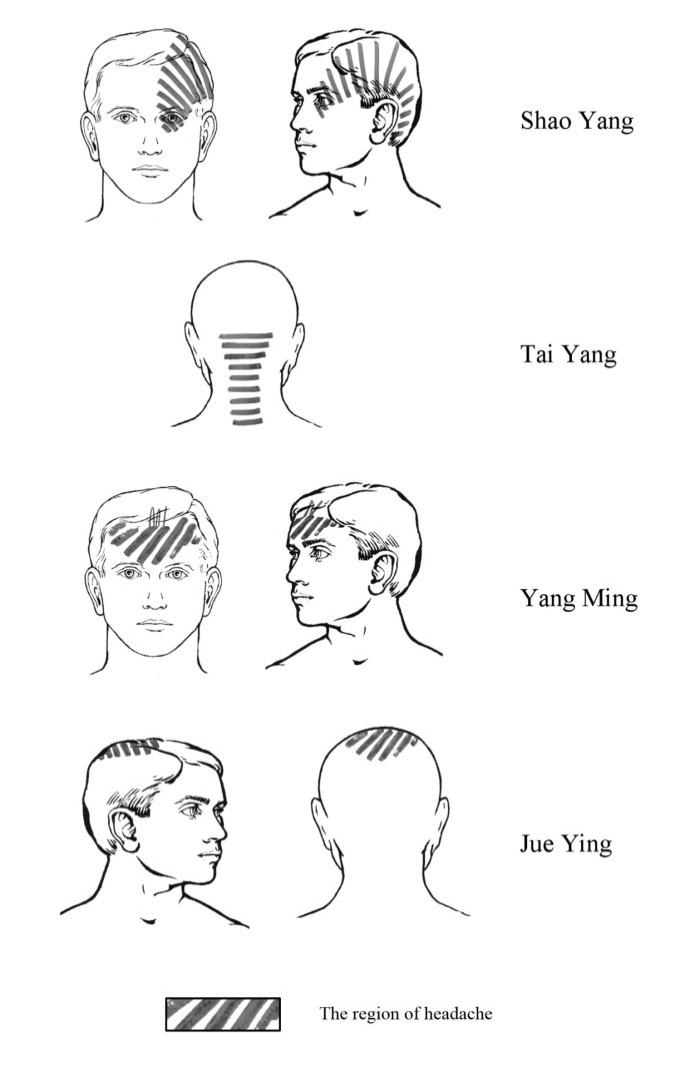
Shao Yang Headache (Leser Yang)
Location of Pain: The sides of the head, often extending to the area behind the eyes.
Cause: This headache is typically associated with a disharmony between the Liver and Gallbladder. It may arise from stagnant Qi or Heat rising, affecting the half-exterior, half-interior level of the body.
TCM Pattern: A half-exterior, half-interior condition affecting the Gallbladder channel.
Yang Ming (Bright Yang)
Location of Pain: The forehead and face, though it may sometimes be felt throughout the entire head.
Symptoms: This headache is often described as an intense, distending pain accompanied by a sensation of heat, persistent thirst, and constipation.
Cause: This pattern is typically rooted in Excess Heat rising from the Stomach or Intestines, which ascends to the head.
TCM Pattern: Excess Heat in the Stomach or Large Intestine channels.
Tai Yang Headache (Greater Yang)
Location of Pain: The back of the head, extending into the neck and upper back.
Cause: This type of headache is typically triggered by an invasion of External Wind, combined with either Cold or Heat. It is often accompanied by noticeable stiffness in the neck, an aversion to cold, and possibly a fever.
TCM Pattern: An exterior condition affecting the Bladder and Small Intestine channels.
Jue Yin (Terminal Yin)
Location of Pain: The vertex, or very top of the head.
Symptoms: This headache is characterized by severe, stabbing pain. Due to its intensity, it may be accompanied by vomiting and cold extremities.
Cause: Jue Yin headaches result from Cold or rebellious Qi rising, often stemming from a dysfunction in the Liver channel.
TCM Pattern: Liver channel dysfunction due to Cold or Stagnation.

External Pathogens
External pathogens originate from the environment and attack the body from the outside, often corresponding to infectious or acute illnesses. They are known as also known as the Six Excesses or Six Evils:
Wind
The primary pathogen often carries other pathogens. Causes acute symptoms, itching, and rapid changes.
Dryness
Damages body fluids, causing dry skin, nose, and throat
Cold
Causes contraction, severe pain, and stiffness. Treat with warmth.
Fire/Heat
Causes inflammation, high fever, and irritability
Dampness
Causes heavy, sluggish sensations and cloudy, sticky discharges.
Summer Heat
Occurs only in summer; causes high fever and extreme thirst
External and Internal Headaches
*TCM patterns and are not referring to the physical, biomedical organs listed below, but rather the Chinese medicine interpretation of these organ systems
External Headaches
External headaches arise when external environmental factors like cold, wind, or dampness affect the body. For instance, a headache triggered by wind-cold often presents as tension and pain concentrated in the back of the head and neck. This type, commonly referred to as a Wind-Cold headache, is typically addressed through treatments aimed at warming the body and dispelling the cold.
In contrast, dampness-related headaches are associated with cold, humid conditions. Symptoms often include a sensation of pressure, heaviness, congestion, and the presence of phlegm. Relief depends on effectively resolving the underlying dampness. Unlike chronic headache patterns, external headaches are generally acute and short-lived.
Internal Headaches
Internal headaches tend to be chronic in nature, stemming from deeper, systemic patterns of imbalance within the body. While the headaches themselves may come and go, the underlying constitutional issues persist. These headaches often arise from factors such as diet, emotional states, or deficiency patterns.
One common internal headache pattern is associated with the TCM diagnosis of Liver Qi Rising. This type of headache is frequently accompanied by feelings of frustration or suppressed anger. Individuals experiencing Liver Qi Rising headaches often describe a sensation of intense pressure.
How TCM Modalities can help:
Acupuncture stimulates specific points to unblock Qi and blood, release endorphins, reduce vascular inflammation, and regulate neurotransmitters to alleviate pain and address the root imbalance.
TuiNa uses rhythmic pressure, kneading, and manipulation along the neck, shoulders, and head to relax hypertonic muscles, improve local circulation, and open stagnant meridians, particularly effective for tension headaches and cervicogenic headaches.
Gua Sha for headaches involves scraping along the neck, shoulders, and upper back to break up stagnation, release fascial tension, and promote localized circulation. It helps reduce the “stuck” pain associated with blood stasis and external wind-cold invasion that often causes headaches.
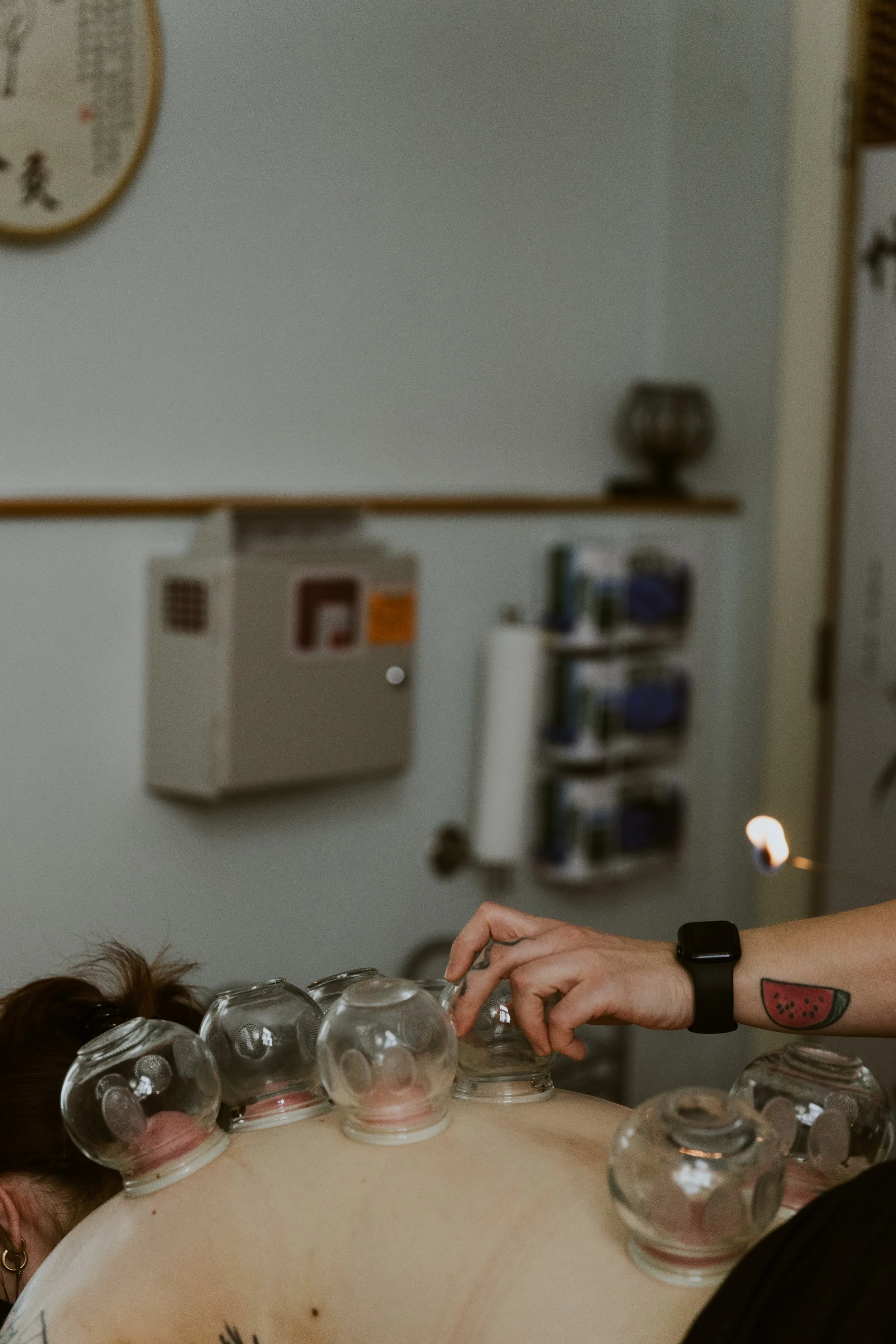
Fire Cupping uses suction to create negative pressure, typically on the upper back and shoulders, to draw out pathogenic factors (like Wind-Cold), relieve muscle rigidity, and move stagnant Qi, making it a great modality for headaches triggered by tension or external pathogens.
Herbal Medicine can provide customized formulas to treat the underlying pattern diagnosis, providing systemic regulation to prevent recurrence rather than just symptomatic relief.
Evidence-based Research & Resources:
Research on Acupuncture and Headaches
Effectiveness and Safety of Acupuncture for Migraine: An Overview of Systematic Reviews
https://pmc.ncbi.nlm.nih.gov/articles/PMC7125485/
The Long-term Effect of Acupuncture for Migraine Prophylaxis
https://jamanetwork.com/journals/jamainternalmedicine/fullarticle/2603492
Blog from American Migraine Foundation (Acupuncture)
Acupuncture for Headaches (Harvard)
https://www.health.harvard.edu/blog/acupuncture-for-headache-201801251513
Research on TCM and Headaches
Mechanism of Traditional Chinese Medicine in Treating Migraine: A Comprehensive Review
https://pmc.ncbi.nlm.nih.gov/articles/PMC11416110/
Identifying Chinese Medicine Patterns of Tension-Type Headache and Understanding Its Subgroups
https://pmc.ncbi.nlm.nih.gov/articles/PMC8483907/#sec5
Integrative East–West Medicine Intervention for Chronic Daily Headache: A Case Report and Care Perspective