


TCM Perspective & Sleep
TCM, the Heart, and Shen
In TCM, the heart (not the physical organ, but the Chinese Medicine heart) is seen as housing the Shen or “spirit.” The Shen governs consciousness, emotions, mental clarity, sleep, and dreaming. During sleep, the Shen and Qi move inward to allow for restful, restorative sleep. When there are vivid dreams, nightmares, or interrupted sleep patterns, the shen is out of balance. Sleep issues such as these - waking up frequently, vivid dreams, nightmares, and light sleep can be related to stress, nervous system overactivity, or difficulty shifting into deep, restorative sleep.
If the Heart is healthy and the Blood abundant, the Shen is properly anchored, and sleep will be sound. If the Heart is deficient or if it is agitated by athogenic factors such as Fire, the Shen is not properly rooted, and sleep will be affected (Macicocia, 2021)
Shen 申 Translation
The word “Shen” can be translated in many different ways, such as “mind”, “spirit”, “consciousness”, “vitality”, “expression”, “soul”, “energy”, “god”, “God”, “psychic”, “numinous”. From a grammatical point of view, it can be a noun, an adjective, or a verb.
The Foundations of Chinese Medicine
Chinese medicine theory can often sound like magical thinking to those not familiar with the concepts or culture. It is based on the history of how historical Chinese doctors viewed the human body, its functions, as well as nature and the body’s connection with the world. Traditional Chinese medicine theory is built upon several key principles that shape its approach to health and healing:
Qi
At the core of Chinese medicine lies the concept of Qi, which is difficult to translate. It is often described as vital energy, life force, or the function of the body systems. Qi has been said to “flow” through the body along meridians, helping to keep the body’s organ systems functioning properly, and when it is in balance, health is maintained. Imbalances or blockages in the flow of Qi are believed to lead to illness and dysfunction of certain organ systems.
Yin and Yang
The balance between Yin (dark, cold, and passive) and Yang (light, warm, and active) is fundamental to Chinese medicine. Health is achieved when these opposing forces are in harmony, and illness arises when they are imbalanced.
Five Elements
Chinese medicine categorizes the body's organs, tissues, and functions into five elements: Wood, Fire, Earth, Metal, and Water. These elements are interconnected and influence each other, providing a framework for understanding the body's functions and imbalances.
What TCM texts say about poor sleep
“Su Wen” in chapter 46 (475-225 b.C):
"When a person lies down and cannot sleep, [it means] the Yin organs are injured [so that] the Jing has no residence and is not quiet, and the person cannot sleep."
"Complete Book of Jing Yue" (1624) by Zhang Jing Yue:
"Overexertion, worrying, and excessive thinking injure Blood and fluids so that the Shen and Hun are deprived of residence and insomnia results".
It also says: "Worrying and excessive thinking injure the Spleen so that it cannot make Blood, and insomnia results".
Restless sleep and vivid dreaming can occur in TCM in these patterns:
*TCM patterns and are not referring to the physical, biomedical organs listed below, but rather the Chinese medicine interpretation of these organ systems
Excess or Deficient Heat in the Heart
This can result from stress, overthinking, hormonal shifts, illnesses/inflammation, or emotional trauma.
Common symptoms: vivid, intense dreams including nightmares, waking often, racing mind, waking feeling fatigued, feeling “wired” or overstimulated.
Liver Qi Stagnation
This can result from stress, depression, and/or hormonal shifts. The liver is responsible for the free flow of Qi. When there is long-term stress or even acute stress, the Qi is said to get stuck and is no longer flowing freely.
Common symptoms: difficulty falling asleep due to overthinking, waking between 1-3 AM frequently, irritability, mood swings, and tight shoulders/neck.
Heart and Kidney not Communicating
Heart (fire) and Kidney (water) should balance each other. However, sometimes these organ systems can get out of balance. This can often occur as we age, due to overwork, illness, hormonal shifts, long-term stress, or burnout.
Common symptoms: night sweats or hot flashes, light sleep/frequent waking (especially 3-5 AM), dreaming, difficulty falling back to sleep, dry mouth, poor memory or concentration.
Digestive System Imbalances
which can be caused by eating too late at night, too many heavy, greasy, rich foods.
Common symptoms: restless sleep after heavy meals, vivid dreams after eating late, bloating, acid reflux, nausea, fatigue after eating, sugar cravings, and brain fog.
TCM Body Clock
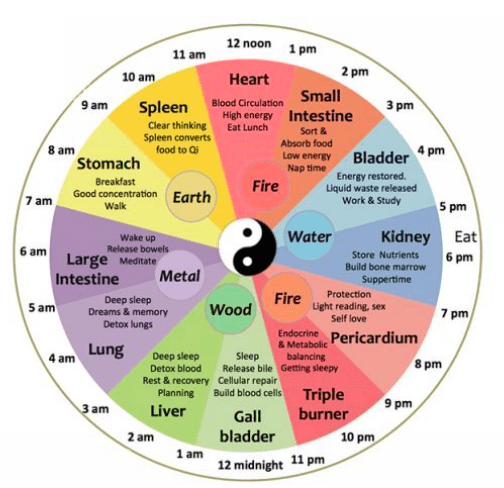
The Chinese Body Clock is a 24-hour schedule that shows when energy (Qi) is strongest in each of the body’s 12 organs. By looking at when you wake up at night or when symptoms flare up, it can reveal underlying imbalances and be a helpful tool for diagnostics.
For example, in Traditional Chinese Medicine, the hours of 1- 3 am are known as 'Liver time.' Your body needs to be asleep right now so it can flush out toxins and make fresh blood. If you often wake up during this time, it might mean your liver is overworked or that you have too much 'yang' energy. On an emotional level, waking then can also be a sign that you're holding onto anger or frustration.

How TCM Modalities can help:
Acupuncture can calm the nervous system, shifting the body out of the fight or flight into the rest and digest phase.
Acupuncture helps balance neurotransmitters like serotonin and dopamine, while increasing nocturnal melatonin secretion, which regulates the sleep-wake cycle.
For those with insomnia caused by chronic pain, acupuncture triggers the release of endorphins, our natural pain relievers, to promote better rest.
Tuina triggers deep relaxation by lowering stress, reducing tight muscles, and improving sleep overall.
Studies indicate that regular Tuina increases 5-hydroxytryptamine (5-HT) levels, which are critical for regulating sleep cycles.
In Herbal medicine, many formulas target "Shen" disturbance (anxiety/racing mind). Common herbs like Suan Zao Ren (Sour Jujube Seed) nourish the heart, while Bai Zi Ren (Arborvitae Seed) eases anxiety and reduces restlessness.
Evidence-based Research:
Research on Acupuncture and Sleep
Role of acupuncture in the treatment of insomnia: a comprehensive review
The effects of acupuncture on sleep disorders and their underlying mechanisms
https://pmc.ncbi.nlm.nih.gov/articles/PMC10442542/
Acupuncture for Treatment of Insomnia
https://pmc.ncbi.nlm.nih.gov/articles/PMC3156618/
Treatment of insomnia based on the mechanism of pathophysiology by acupuncture combined with herbal medicine: A review
Research on Tuina and Sleep
Effect of tuina on sleep quality, psychological state, and neurotransmitter level in patients with insomnia: a systematic review and meta-analysis
https://pubmed.ncbi.nlm.nih.gov/38450067/
Research on Herbal Medicine and Sleep
Chinese herbal medicine for insomnia: A systematic review and network meta-analysis
https://pmc.ncbi.nlm.nih.gov/articles/PMC12366933/
Effectiveness and safety of Chinese herbal medicine Xiaoyao san for the treatment of insomnia
Treatment of insomnia based on the mechanism of pathophysiology by acupuncture combined with herbal medicine: A review